While You Sleep, They're Shaping Your Breakfast: The Night Shift That Powers NYC's Bagel Culture
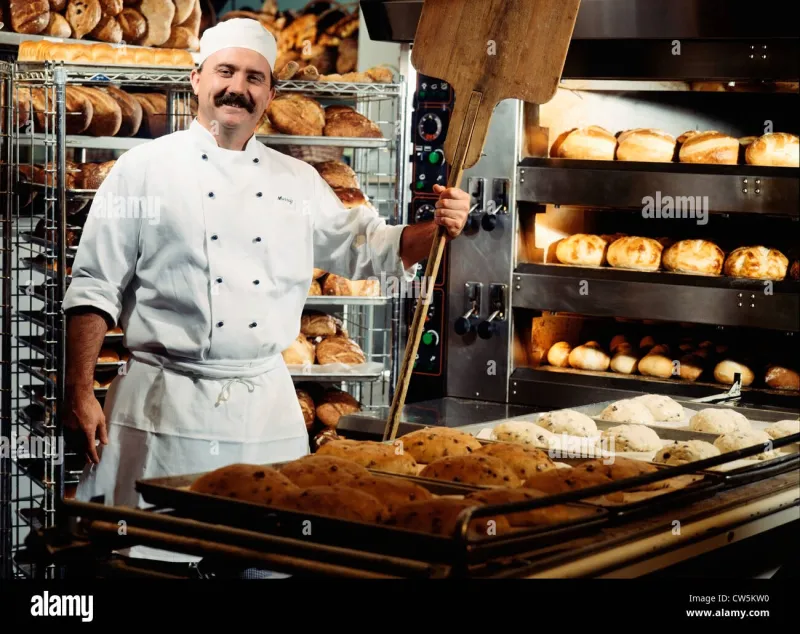
Photo: baker working overnight in commercial bakery kitchen shaping bread dough, via c8.alamy.com
The city that never sleeps has a secret keeper: the bagel baker. While most New Yorkers are somewhere between their second REM cycle and their third snooze alarm, a small, dedicated crew is already elbow-deep in dough. Flour on their forearms, steam rising off the kettle, the hum of a proofing rack in the background. It's 2:47 AM, and the work has been going for hours.
This is the graveyard shift that built New York's bagel empire — and it's more science than romance, even if it looks like both.
Why Overnight? The Fermentation Answer
Ask any serious bagel baker why they start in the dead of night and you'll get some version of the same answer: the dough doesn't care what time it is, but time cares deeply about the dough.
Traditional New York bagel production relies on a cold, slow fermentation process. After the dough is mixed and shaped, it goes into refrigerated retarders — large, walk-in coolers that hold the shaped rings at a temperature just high enough to keep the yeast alive but slow enough to stretch the fermentation window across many hours. That extended cold proof is where flavor actually develops.
During slow fermentation, yeast consumes sugars gradually and produces carbon dioxide along with a range of organic acids and esters — the compounds responsible for that subtle tang, the slightly chewy crumb, the crust that cracks just right when you bite through it. Rush that process with warmer temps or a shorter timeline, and you get a bagel that's technically correct but emotionally empty. It puffs up fine. It just doesn't taste like anything worth waking up for.
That's why the clock matters. Bakers need to time the mix, the shape, the retard, the boil, and the bake so that everything lands at the right moment — which means working backward from a 6 or 7 AM opening and building a schedule that starts well before midnight.
The Rhythm of the Night
For most bagel bakers on the overnight shift, the night breaks into distinct phases that feel almost ritualistic after enough repetitions.
The early hours — say, 10 PM to midnight — are about mixing and portioning. Large batches of high-gluten dough come together in commercial spiral mixers. The hydration level is dialed in carefully; too wet and the bagels spread, too dry and they won't develop the right chew. Once the dough is ready, it gets divided and run through a bagel former or hand-rolled, depending on the shop's approach.
From roughly midnight to 3 AM, the shaped bagels go into the retarder. This is the quiet stretch — the part of the night where bakers catch their breath, clean equipment, prep toppings, or simply wait. The yeast is doing the heavy lifting now.
Around 3 to 4 AM, the boiling begins. This is where New York's bagel identity is most visibly expressed. Rings of dough drop into a rolling pot of water — sometimes laced with malt barley syrup, sometimes plain — and float to the surface within seconds. They're flipped, pulled, drained, and topped before heading into a deck oven that runs somewhere between 450 and 500 degrees. The oven's radiant heat sets the crust fast and gives the interior time to finish cooking through.
By 5 or 5:30 AM, the first trays are out. By the time the morning rush hits, hundreds of bagels have already lived a full life.
What Would Be Lost
Automation has made real inroads in commercial baking. Larger operations can now automate shaping, boiling, and even some aspects of fermentation management. So why do so many of NYC's most respected shops still run a full human crew through the night?
The honest answer is partly practical and partly philosophical.
On the practical side, dough is genuinely unpredictable. Humidity changes. Flour protein levels vary batch to batch. Ambient temperature in a kitchen fluctuates depending on what the oven's been doing. An experienced baker reads these variables in real time and adjusts — adding a few minutes to the proof, tweaking the boil time, pulling a batch ten seconds early because something in the color says it's ready. Machines optimize for consistency within a fixed set of parameters. Skilled bakers optimize for quality within a constantly shifting environment.
On the philosophical side, there's something that bakers return to again and again when you ask them about the overnight: presence. The act of being there, of watching and touching and smelling the dough through every stage, creates a relationship with the product that shapes how they think about it. Bakers who've spent years on the overnight shift develop an almost intuitive sense for what good dough feels like at each stage. That embodied knowledge is hard to replicate and harder to transfer.
"You can write down a recipe," one baker told us, "but you can't write down what the dough tells you at 3 in the morning."
The Human Cost — and Why They Stay
Let's not romanticize this too hard. The overnight shift is genuinely brutal. Bakers talk about the first few months as a kind of endurance test — learning to sleep in the afternoon, missing evening social life, recalibrating their entire sense of when a day begins and ends. The physical demands are real too: standing for hours, lifting heavy mixer bowls, working in a hot environment while the rest of the world is unconscious.
Turnover in bakery kitchens is notoriously high. The overnight shift filters for a specific kind of person — someone who finds meaning in the craft itself rather than in the conditions surrounding it.
What keeps people? Mostly, they say, it's the product. There's a particular satisfaction in pulling a perfect tray of bagels out of a deck oven at 4:30 AM, knowing you built that from scratch over the last six hours. The morning rush that follows — the line out the door, the regulars who order the same thing every day without looking at the menu — that's the payoff. Bakers rarely see it. They're usually home by then. But they know it's happening.
The Science Behind the Pride
It's worth pausing on what the overnight process actually produces from a food science standpoint, because the results are measurable, not just sentimental.
Slow cold fermentation produces more complex flavor compounds than fast fermentation at room temperature. The Maillard reaction — the browning process responsible for crust color and roasted flavor notes — is influenced by the sugar content of the dough at the time of baking, which is itself a product of how fully the yeast has metabolized. A properly retarded bagel arrives at the oven in a different chemical state than a rushed one, and that difference shows up clearly in the final product's flavor depth, crust texture, and shelf life.
The boiling step, which gelatinizes the outer layer of starch before it hits the oven, also benefits from dough that has fully relaxed during the cold proof. Properly fermented dough holds its shape in the water and comes out with that characteristic sheen. Under-proofed dough can be gummy, or it can blow out at the seam, or it can simply taste flat.
None of this is magic. It's chemistry and biology, playing out on a schedule that happens to align with the hours between midnight and sunrise.
The Bagel at Dawn
The next time you pick up a fresh bagel in the morning — still warm, crust intact, the crumb giving just slightly under your fingers — consider what it took to get there. Someone was up at midnight mixing that dough. Someone was checking the retarder at 2 AM. Someone pulled it out of 500-degree heat before you set your alarm.
The overnight shift isn't a quirk of the bagel business. It's the engine underneath everything that makes a New York bagel worth eating. The science demands it. The craft rewards it. And the bakers who live by that clock are, in their own quiet way, the reason this city wakes up as well as it does.